
Cookies on the Harper Adams University website
We use cookies to ensure that we give you the best experience on our website. If you continue without changing your settings, we'll assume that you are happy to receive all cookies on the website. However, you can change your cookie settings at any time.
A decade ago, every harvest in the history of farming had been sown, tended and gathered by human hands – until Harper Adams University changed the world.
The idea was simple: planting, tending and harvesting crops without a human setting foot on the land.
The first work on the Hands Free Hectare began exactly 10 years ago and its first harvest followed twelve months later, in September 2017.
The impact of that work inspired new thinking among researchers, engineers and companies around the globe.
A decade later, a new generation inspired by the visionary work is honing research at the University.
They’re seeking to take the work of machines and make it more human, using robots that not only act like us - but that will, ultimately, make decisions like us too.
This is the story of how one 100 metres square plot in Shropshire changed the world of agricultural technology – and where those inspired by its work think we’ll go next.

The first Hands Free Hectare harvest
an idea taking root
Senior Engagement Fellow in Engineering Kit Franklin, whose career began as a Harper Adams engineering student, was one of the founding members of the Hands Free team.
He recalls: “I came to Harper Adams, where I studied Agricultural Engineering, because I wanted to design and develop the next generation of machines.
“But whilst I was here, I gained some new perspectives on farming, and I started to feel that farm machinery had got too large.”
Reducing the size of farm machinery enables greater precision and improves soil health - it reduces compaction in the soil, improving farm sustainability .
At Harper Adams, the late Professor Simon Blackmore, a pioneer in agricultural robotics and automation, had already foreseen these changes – and where agricultural engineering could go next.
However, as Kit recalls: “Simon was talking about using smaller, lighter, more precise robots to do farming.
“But we had a problem - the imagery was very sci-fi… if you showed that to a farmer, they would often turn straight off.
“If you go ‘Right, in the future, you're going to farm with 10 autonomous robots that look like this rather than one tractor. It's going to be smaller, lighter, better for your soil, more precise for your plants…’
“They'd all say, that all sounds great, but that's science fiction, mate! That's never going to happen in my lifetime.
“The key with Hands Free is we used tractors that looked like tractors, and we used a combine that looked like a combine - because we wanted it to be entirely relatable and prove the point that ‘autonomous’ did not necessarily mean ‘science fiction.’
“It meant ‘the next evolution of where we are today.”
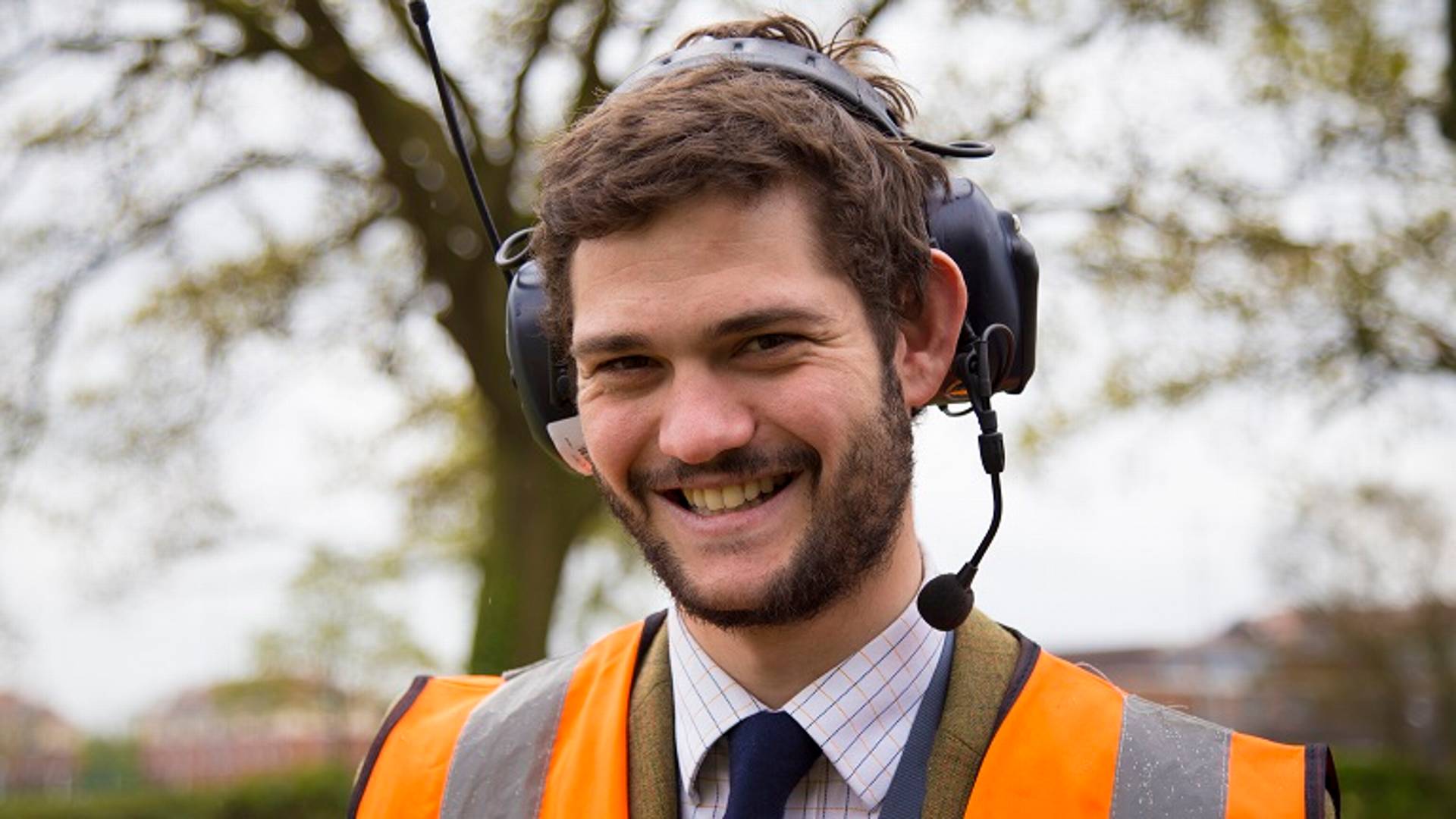
Kit Franklin, Senior Engagement Fellow in Engineering and founding member of the Hands Free Hectare team.
the next evolution
While the idea behind the project was deceptively simple, the challenges the team faced were not.
They had the same issues with their automated machinery and drones as any other farmer: seasonal time pressure, machinery reliability, field obstacles – and, of course, the great British weather.
A self-driving tractor had to prepare the site for spring barley to be sown.
A robot scout had to gather soil and plant samples to check the health of the crop.
A drone with a modified dog-poo scooper was sent out to gather ears of barley to check its quality prior to harvest.
Live-streaming helped advisors offer their best assessment of the viability of the crop as it ripened.
By the autumn of 2017, an adapted 25-year-old combine was gathering four and a half tonnes of barley from the site – and plans for Hands Free beer and gin were underway to toast the team’s success.
The realism of their vision – showing farmers the art of the possible with machines they knew from their own fields - captured the imagination of the world.
Reporters descended upon Shropshire from around the globe, and a media frenzy began – with the story of the Hands Free Hectare told in more than 85 countries.
Listen: Brash Ag
Kit now runs a popular podcast with fellow engineer Ray King.
In this episode, they caught up with Jonathan Gill - one of the original Hands Free team - to reflect on the past 10 years. Jonathan shares some fascinating insights into the development of drone tech and how his passion for this technology shaped his career and helped to launch the Hands Free Hectare.
Global Impact and Engagement
In Chennai, India, TAFE – one of the world’s largest tractor manufacturing companies – immediately saw the potential of the research.
TAFE worked with the Hands Free team to set up their own test field in Chennai, and forged an international collaboration, working with the team and other Harper Adams researchers across a range of engineering projects.
Speaking at the time, TAFE Director and Group President, Mr T R Kesavan, described the collaboration as a "reaffirmation of TAFE’s commitment to its vision of ‘Cultivating the World’, as it aims to combine integrated farming techniques with precision agriculture and engineering to develop sustainable farming models that work for both marginal and large farms".
In the United States, Kit and the team’s work caught the eye of Dr Alex Thomasson, now the Director of Mississippi State University’s Ag Autonomy Institute.
Alex had met Professor Blackmore in China and was taken with his vision, and as the Hands-Free Hectare developed, he saw how its work and his could complement one another.
He said: “They were really the world’s first to do this work, and I felt like aligning myself in the work we wanted to do here with them was a very good move for us.”
Watch: Ag Autonomy Institute
Dr Alex Thomasson, Director of Mississippi State University’s Ag Autonomy Institute, reflects on his connections with Harper Adams University and the Hands Free Hectare team
INSPIRING A FURTHER EVOLUTION
In Valpariso, Chile, an Associate Professor working on agricultural robotics saw the work of the Hands-Free team – and imagined where it could take his own research.
Fernando Auat Cheein, who now serves the Director of the Harper Institute of Technology, said: “We were studying the deployment of fully robotised machinery into farming when we saw the project on the media.
“At that time, the project made me think that fully robotised farms might be a reality in the short term.
“The Hands-Free Hectare - plus the work already done by Professor Blackmore and many others worldwide - helped me to shape my own vision.
“The outcomes of the Hands-Free Farm are not only about what you can show from a research point of view, but I think more importantly, what you can show with existing abilities and capabilities.
“Kit and his team demonstrated to the UK and the world that fully autonomous farming was actually possible.”

Fernando Auat Cheein, Director of the Harper Institute of Technology.
so, what's next?
Kit recalls that there was one question everyone asked when the Hands-Free story reached them - when would the technology be commercially available?
“I would tell them it would be unsurprising to see an autonomous vehicle by the mid-2020s. I think I was, arguably, correct. You can drive around the countryside now and you will see ag bots. I'm going to see one tomorrow that's light weeding - the Earth Rover CLAWS.
Near Harper, there's people running Farm-Droids, solar-powered seeding and weeding robots. Jeremy Clarkson has demonstrated an AgXeed autonomous tractor on his show.
“These things all exist.
Some of these companies have sold hundreds of machines across the world. Yet if we go back to Hands-free, our machines were entirely stupid. They were following a predetermined route plan and a predetermined set of rules. What we did with Hands-Free was not robotic, it was autonomous.
“The next step is, I think, robotics - where there is that element of decision-making by the machines.”
enter fernando - developing humanoid robots at harper adams
“Automation is not the same as robotisation. Automation means no decisions. Robotisation means that robots will make decisions. What I see with my work with humanoids is quite different to what the Hands-Free Farm showed,” says Fernando.
“Each one of the robots that you have now has a solution, it's basically an ad-hoc solution. So, you have the problem, and you have a robot to solve that specific problem. And the robot cannot be used elsewhere, or to solve a different problem."
Centuries of human involvement have shaped lots of agricultural and horticultural tasks – particularly those beyond the capabilities of the Hands-Free machines.
Fernando added: "A humanoid has the same degree of freedom, the same ability as the human body, so we can programme the robot not to solve one problem, but to solve many of them."
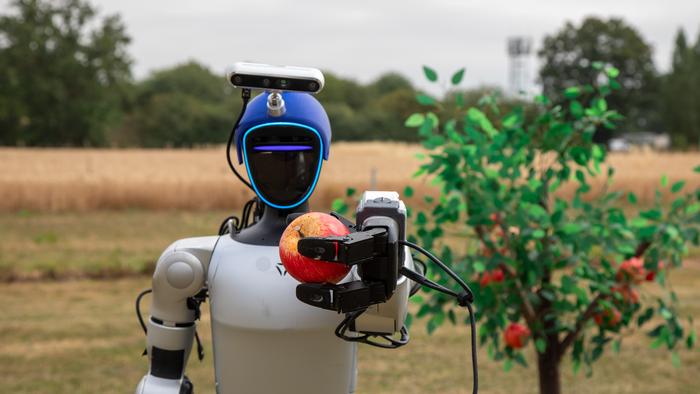
an intelligent machine?
Many, more complex, tasks have proven to be beyond automation, not only because of the task itself, but because completing it successfully requires not only the body, but also the mind.
Kit notes: “The glaring hole in the wider agricultural and horticultural world is all the things that haven't yet even been mechanised, because the problem behind them is difficult.
“Take harvesting apples. Some of the apples are ripe, some of the apples aren't. Some of the stems on this plant need pruning, some of the stems don't need pruning.
“A human intrinsically feels how hard to pull on an apple or how much to twist an apple to break it off.
“A robot that’s simply been programmed might work five times out of ten, because every apple is different.
“Mechanising that has been nearly impossible, and we're essentially entirely reliant still on manual labour. You cannot make a machine - a dumb, repetitive machine - do those tasks. You need an intelligent machine to do those tasks.
“AI can learn for itself and create its own optimum outputs. So how do we start linking that with mechanical robotic systems?
“If you put a robot into a field, into an orchard to pick apples, if it was working surrounded by humans picking apples, could it watch what the humans were doing and learn from the human motion and put that human motion into an autonomous system?”
“... we're essentially entirely reliant still on manual labour. You cannot make a machine - a dumb, repetitive machine - do those tasks. You need an intelligent machine to do those tasks."
Kit Franklin
the difference a decade makes
These are the challenges Fernando and his team are seeking to solve in the coming decade.
He adds: “Many things have happened in the last 10 years, and right now one of the biggest challenges we face in robotisation or automation in farming is generalisation.
“We need to find technologies that can be used in different locations, different environments, and to do different tasks.
“Our other key challenge is adoption: technology is too complicated, right now, to be handled by any person.
“But we are getting there, by having new standards, regulations, and advancements that serve as a basis for our research and for the development of new technology.”
For Kit, it is precisely the rapid pace of technological advancement over the past decade that offers some of the most tantalising prospects.
“What has changed in the 10 years since the Hands-Free project is that humanoids really do exist.
“Fernando and his team are developing a humanoid machine in our very own engineering department that walks around and does horticultural tasks.
“That is quite an amazing leap in 10 years.
“And it's quite an interesting capability leap for Harper Adams - 10 years ago, we were using GPS technology to automate the driving of a tractor.
“Now we're using GPS to navigate a biped humanoid robot.”
Listen: Robot Farmers
Could robots already be responsible for the food on your plate without you even knowing?
Fernando's work is already catching the eyes of the media. He told the BBC’s Paul Shuttleworth about his work so far, where things go next - and why robot farmers might even need to develop some social skills...


Harper Adams University thanks all companies and partners who are supporting our 125th anniversary programme. As a specialist institution, we especially value collaboration and engagement with organisations and companies within and related to the agri-food sector. Co-investment from sponsorship and donations is helping the University extend what we can do through our teaching, research and societal engagement.
Principal Partner

Official Launch Partner
